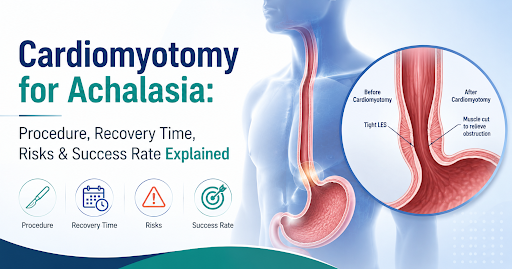
Achalasia cardia is a rare condition affecting the esophagus, which results in trouble with swallowing. The condition happens due to poor relaxation of the lower esophageal sphincter (LES), the ring of muscles separating the food-pipe and stomach. As a result, there are difficulties for food and liquids to pass into the stomach, causing such symptoms as swallowing problems, regurgitation, chest pain, and weight loss. Although endoscopic therapies have now come in, in case of moderate to severe cases of achalasia, cardiomyotomy for achalasia is one of the best treatment approaches that can help to manage the symptoms effectively.
Understanding Achalasia and Its Impact
Swallowing of food and drink is accomplished through coordinated muscle movements inside the esophagus/ food-pipe. In patients with achalasia cardia, nerves responsible for these muscle contractions are damaged. Thus, the function of the process of food transfer from the food-pipe into the stomach, as well as relaxation of the LES, is disturbed.
The most common symptoms are as follows:
- Difficulty swallowing solids and liquids
- Food regurgitation
- Chest discomfort or pain
- Persistent coughing, especially at night
- Heartburn-like symptoms
- Unexplained weight loss
Untreated achalasia can negatively impact one’s nutritional state, everyday routine, and quality of life.
What Is a Cardiomyotomy?
The cardiomyotomy procedure is an operation aimed at loosening the lower esophageal sphincter muscle. In the course of the procedure, the surgeon carefully makes cuts in the muscle tissues of the LES to allow for easier passage of food and liquids into the stomach.
The most common type of procedure is Heller’s Cardio-Myotomy, which is usually performed by a minimal access technique. It is usually accompanied by a partial fundoplication procedure that is done to prevent post-surgical reflux problems.
How the Procedure Is Performed
The modern cardiomyotomy procedure has become much easier compared to the traditional surgery. The procedure is usually conducted under general anesthesia and requires only small incisions instead of a large surgical cut.
The procedure usually consists of:
- Making small incisions in the abdomen.
- Introducing the laparoscope and special surgical tools into the body.
- Locating the lower esophageal sphincter.
- Carefully cutting the affected muscle tissues.
- Checking the condition of the area to make sure that the passage is opened properly.
- Concomitant anti-reflux procedure if necessary.
Laparoscopic surgery for achalasia cardia usually takes 60 to 90 minutes, depending on the patient’s medical condition.
Who May Benefit From This Surgery?
Surgical cardiomyotomy can be considered for those with the following criteria:
- Experience difficulties in swallowing
- Have symptoms that do not respond to non-surgical approaches
- Not gained any permanent relief through balloon dilatation
- Suitable medically to undergo the procedure
- Looking for a long-term solution
This will be decided based on your assessment, along with diagnostic tests like esophageal manometry, barium swallow study, and endoscopy.
How Is Achalasia Diagnosed Before Surgery?
A variety of tests are conducted before the recommendation of surgery to confirm the presence and seriousness of achalasia. Diagnosis will help to determine the best treatment choice for the patient, that is, cardiomyotomy. In addition, the diagnosis of the condition will ensure the exclusion of any other possible cause of the disorder that can cause the same signs, like acid reflux and esophageal strictures.
Some of the tests used for the diagnosis of achalasia are esophageal manometry, which helps to test the functioning of the muscles of the esophagus, barium swallow test that reveals the way foods move through the digestive system, and upper GI endoscopy that allows examining the esophagus and the stomach.
What to Expect During Recovery
Patients tend to recover faster when surgery is done via minimally invasive methods.
Once the procedure is done, monitoring will be done in case of any complications that may arise. Patients will be gradually introduced to drinks until they start taking soft foods. Patients are expected to go back home between one and three days, depending on how well they have recovered.
Some of the recovery milestones include the following:
First Week
- Discomfort around the incision area
- Liquid or soft food diet
- Gradual increase in physical activities
Two to Four Weeks
- Able to swallow
- Start engaging in light daily activities
- Diet adjustment as per the advice of the surgeon
Four to Six Weeks
- Resume most activities
- Eating and drinking greatly improved
- Continue with follow-up visits
Most patients who undergo cardiomyotomy for achalasia usually experience a marked improvement in their symptoms soon after the procedure.
Potential Risks and Complications
Any kind of surgical procedure has its own risks involved. However, in most cases, when done by skilled surgeons, the risks are minimized.
Some of the risks include the following:
- Bleeding
- Infection
- Damage to the esophagus or stomach
- Surgical site leakage
- Reaction to anesthesia
- Gastroesophageal reflux disease (GERD)
The majority of the possible problems are rare and may be effectively dealt with when identified in time. Careful planning of the operation as well as the post-surgical supervision plays a key role here.
Success Rate and Long-Term Outcomes
In achalasia treatment, cardiomyotomy shows excellent long-term effects. Various clinical trials have confirmed its high efficiency, as many patients showed great improvements in swallowing functions and other symptoms.
Possible benefits are:
- Decreased difficulty swallowing
- Improved nutrition intake
- Increased quality of life
- Reduced regurgitation
- Long-term symptom management
Some patients experience minor reflux symptoms after the surgery, but they may be managed using medications, proper diet, or special prophylactic surgical maneuvers that are performed in the course of the operation.
Long-term follow-up is important to monitor outcomes and ensure continued symptom control.
Life After Surgery
Many patients are in a position to resume their regular diet and routines after having undergone successful therapy. Healthy eating habits would help in the healing process.
Some useful tips for a healthy lifestyle include:
- Eating small portions
- Chewing your food well
- Remaining upright after eating
- Taking enough water
- Abiding by the dietary advice offered by your health care providers
Follow-ups help the surgeon assess the patient’s progress and handle any issues that might arise.
A Step Toward Comfortable Swallowing and Better Health
Achalasia cardia can be both physically and mentally challenging, yet there is a wide array of treatments available for patients living with the condition. Cardiomyotomy for achalasia is among the most efficient and reliable methods of ensuring that the patient resumes swallowing and lives a better quality of life. If you wish to find an expert in minimally invasive surgery, you should consider MetaHeal – Laparoscopy and Bariatric Surgery Center, which has a great reputation when it comes to complex gastrointestinal surgeries and laparoscopic procedures.