


Assessment of the Hernia
Clinical examination and imaging where required help assess the size, location, contents, and complexity of the incisional hernia.
A minimally invasive surgical procedure to repair a hernia that develops through a previous surgical incision and reduce the risk of complications associated with an untreated hernia.
Understanding Incisional Hernia
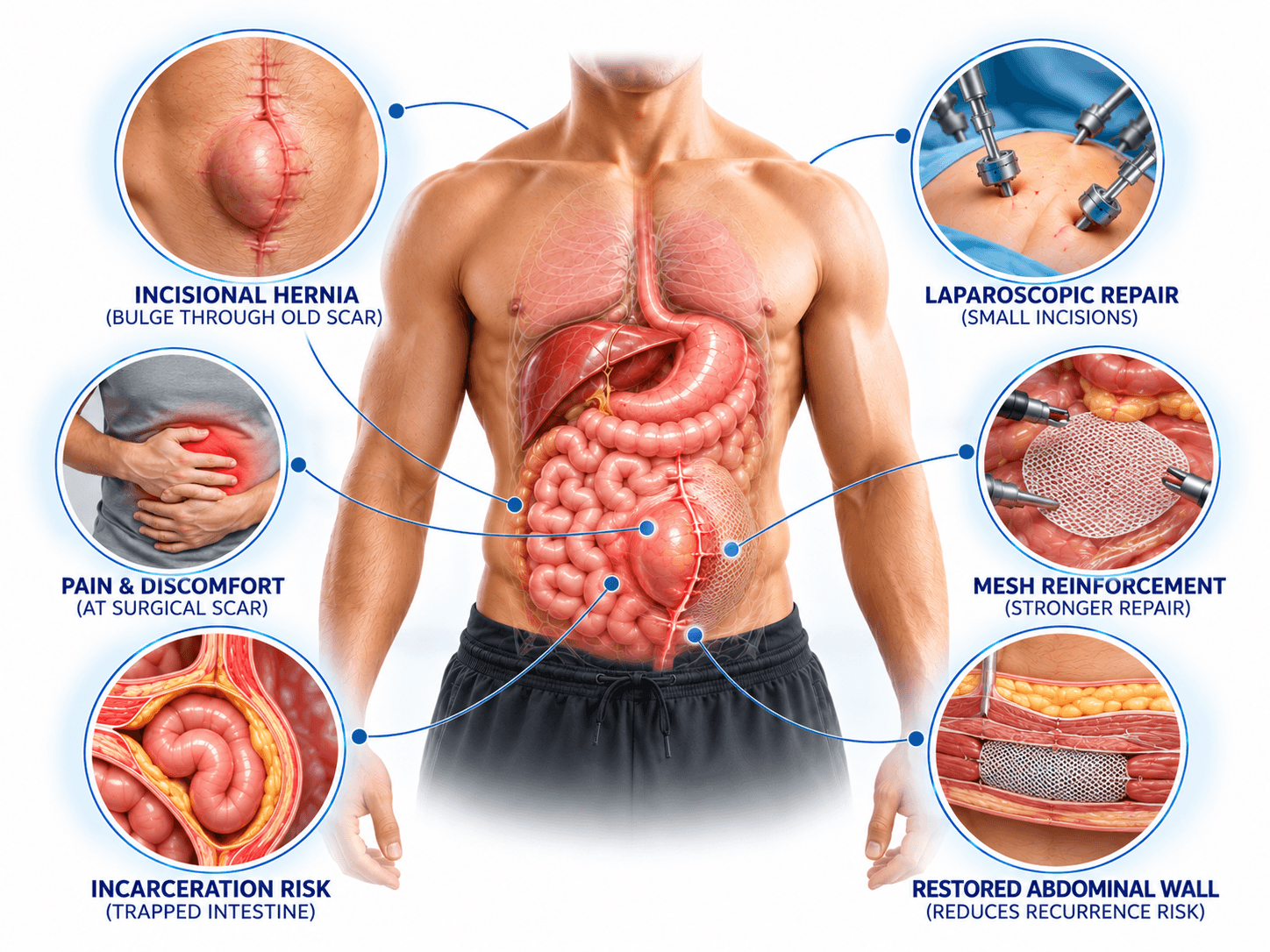
An incisional hernia develops through a weakness in the abdominal wall at or near a previous surgical incision. It may occur when the incision does not heal adequately and can become larger over time.
Factors that may contribute to the development of an incisional hernia include obesity, diabetes, chronic obstructive pulmonary disease, surgical site infection, use of corticosteroids, certain chemotherapeutic agents, and poor wound healing.
An incisional hernia may initially appear as a swelling through a previous surgical scar. The swelling may become more prominent with coughing or straining and may reduce when lying down.
If the hernia becomes irreducible, painful, red, or tender, it may indicate incarceration or strangulation and requires prompt medical evaluation.
How Incisional Hernia Surgery Works
Diagnosis is primarily based on clinical examination. Imaging such as ultrasound may also be recommended to assess the size of the defect, contents of the hernia, and appropriate repair approach.
Clinical examination and imaging where required help assess the size, location, contents, and complexity of the incisional hernia.

Small abdominal incisions may be used for the laparoscope and surgical instruments. The abdominal cavity is assessed, and adhesions are carefully released where required.

The hernia contents are identified and returned to the abdominal cavity, after which the abdominal wall defect is repaired.

An appropriately selected synthetic mesh may be placed to reinforce the abdominal wall and support the repair.

Larger or complex defects, certain lower abdominal or lumbar hernias, defects close to the ribs, multiple previous surgeries, abdominal wall infection, intestinal obstruction, or emergencies may require an open approach or abdominal wall reconstruction.
Who Should Consider Incisional Hernia Surgery

Have a swelling or lump through a previous surgical scar.

Have pain or discomfort around the hernia.

Have a hernia that is increasing in size.

Have a hernia that becomes difficult or impossible to push back.
Have an incarcerated or irreducible hernia.
Have symptoms suggesting intestinal obstruction.
Have a strangulated hernia requiring urgent treatment.
Have multiple previous abdominal surgeries or a complex abdominal wall defect requiring detailed surgical evaluation.
Benefits of Incisional Hernia Surgery
Smaller abdominal incisions
Better visualisation of the abdominal cavity
Assessment and treatment of intra-abdominal adhesions
Identification of additional or previously unrecognised hernia defects
Less postoperative pain and discomfort compared with open surgery in suitable patients
Earlier mobilisation and recovery
Mesh reinforcement of the repaired abdominal wall

Laparoscopic repair can be particularly useful in appropriately selected patients, including those with obesity. The surgical approach is determined by the size, location, complexity, and characteristics of the hernia.
Possible Risks & Side Effects

Temporary pain or discomfort may occur during recovery after incisional hernia repair.

Bleeding may occur during or following surgery.

Infection may develop at the surgical site or involve the mesh in some cases.

A seroma or fluid collection may develop in the area of the repaired hernia.

Adhesions or intestinal obstruction may occur in some patients after abdominal surgery.

Complications related to the surgical mesh may occur in some cases.
The incisional hernia may recur after surgical repair in some patients.
In complex repairs with significant loss of abdominal wall domain, closing the defect may increase intra-abdominal pressure and potentially contribute to respiratory problems or abdominal compartment syndrome.
*Complex incisional hernias require careful surgical planning to reduce the risk of abdominal wall, respiratory, mesh-related, and postoperative complications.
Our Approach to Incisional Hernia Surgery

01
Clinical examination and, when required, imaging help assess the size, location, contents, and complexity of the incisional hernia.

02
The surgical approach is selected based on the hernia characteristics, previous surgical history, abdominal wall condition, and overall health.
03
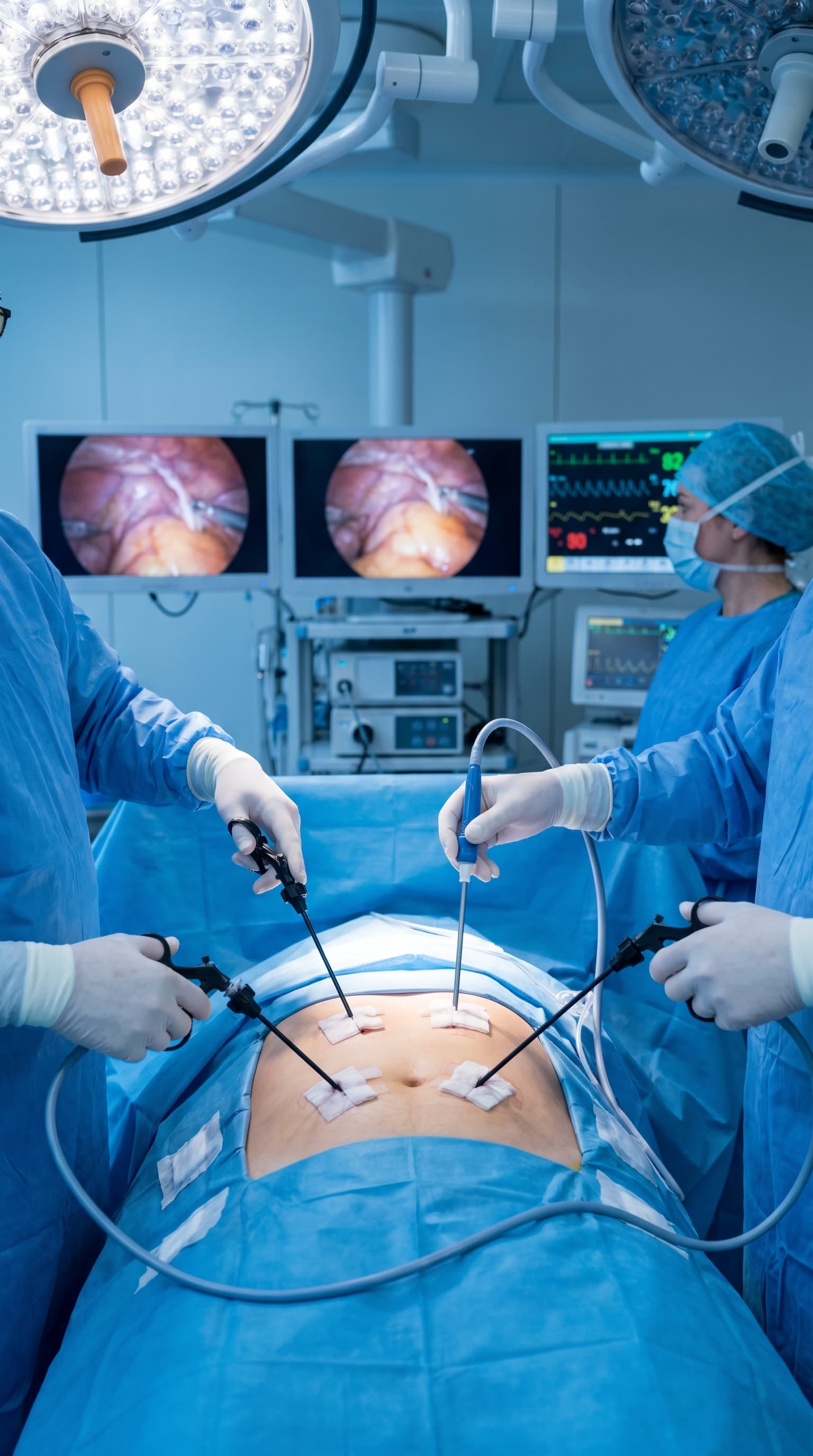
Where feasible, laparoscopic surgery allows the abdominal cavity to be assessed, adhesions to be addressed, the defect to be repaired, and mesh to be placed for reinforcement.

04
Patients receive guidance on wound care, pain management, mobility, abdominal support, lifting restrictions, and gradual return to normal activities.

05
Follow-up helps monitor healing, recovery, abdominal wall function, and any signs of recurrence or complications.
Frequently Asked Questions
Incisional hernias do not have a permanent medical treatment. Surgery may sometimes be deferred temporarily for a reducible hernia or when a patient is not medically fit for surgery. However, irreducible or strangulated hernias require prompt surgical evaluation and may require emergency surgery.
Your surgeon will recommend the required investigations and assess whether you are medically fit for surgery. If you take blood-thinning medication, your doctor will advise you on whether and when it needs to be stopped before surgery. Admission may be planned on the morning of surgery or the previous evening, depending on your treatment plan.
Some postoperative pain or discomfort is expected. Laparoscopic surgery may result in less postoperative discomfort compared with open surgery in appropriately selected patients. Pain medication is provided during the recovery period as required.
The length of hospital stay varies according to the surgical approach, complexity of the hernia, and the patient's clinical condition. Patients undergoing incisional hernia repair may require a few days of hospitalisation depending on their recovery.
A hernia can recur after repair in some cases. Recurrence may be influenced by factors such as the size of the defect, abdominal wall strength, mesh selection and size, activity level, and other patient-related factors. Appropriate surgical planning and follow-up are important for long-term recovery.

Incisional Hernia Care Insights
Consult with an experienced specialist and take the first step toward better health, improved quality of life, and long-term wellness through advanced bariatric, laparoscopic, and robotic surgical care in Mumbai.




3K+ Satisfied Patients